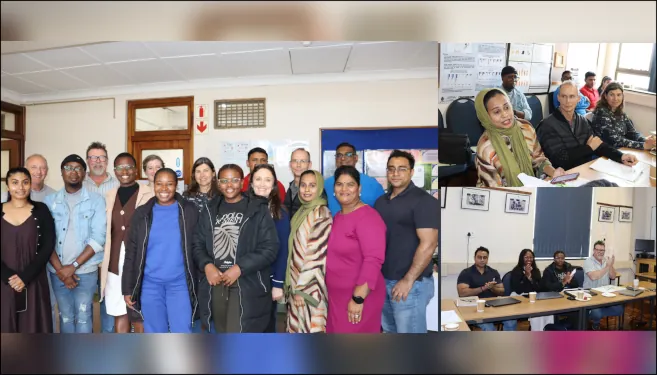
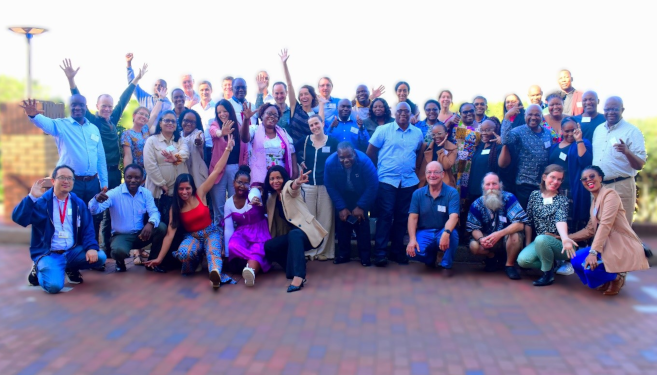
From 4-6 June, 2024, the Sustainable and Healthy Food Systems – Southern Africa consortium (SHEFS-SA) convened a pivotal gathering of stakeholders dedicated to leading regional food systems and communities towards systems and communities that are healthy and resilient to climate risks.
This hybrid event, which combined in-person and virtual participation, underscored the crucial role of collaboration in achieving these goals.
The initial SHEFS project, which ran from 2017 to 2024, has significantly enhanced our understanding of the complex interconnections between food systems, health, and the environment. This success is attributed to its multidisciplinary research and extensive stakeholder engagement. As the Wellcome Trust-funded work transitions from SHEFS to SHEFS-SA, which will run for a further six years, the group is focused on integrating the valuable insights gained, addressing any gaps identified, and taking forward any important questions that remain unanswered.
The SHEFS project highlighted the necessity for localised solutions, adaptable strategies, and a stronger focus on gender equity and social inclusion. It also demonstrated the value of the deliberate development of a transdisciplinary Community of Practice that brings together diverse stakeholders who share common goals and interests within an expanded climate sensitive SHEFS-SA framework, thus enhancing knowledge co-production, building relationships and the capacity to bring about change, improve food security, food safety, nutrition, and health – including mental health.
Building upon the solid foundation of SHEFS, SHEFS-SA aims to incorporate key learnings and address existing gaps. This includes developing context-specific strategies tailored to Southern Africa’s unique challenges and opportunities, implementing a comprehensive Monitoring, Evaluation, Learning, and Impact Assessment (MELIA) plan, and formulating a thorough Gender, Equity, and Social Inclusion (GESI) strategy to ensure interventions are inclusive, equitable, and empower marginalised groups. SHEFS-SA will maintain the emphasis on building a Global South-led Community of Practice, expanding the network to include partners from Malawi and Zimbabwe, and from new fields as the scope of the work has evolved.
SHEFS-SA will focus on several key workstreams to achieve its objectives:
– Promoting Sustainable Farming Practices and Biodiversity Conservation
– Investigating the Connections between Diet, Nutrition, and Health Outcomes
– Enhancing Food Access and Affordability for Vulnerable Populations
– Collaborating with Policymakers to Support Sustainable and Healthy Food Systems
– Co-developing Solutions with Communities to Ensure Cultural Relevance and Acceptance
In addition to these primary components, SHEFS-SA will explore innovative technologies, sustainable business models, and climate resilience strategies. By leveraging advanced research and technology, the project aims to drive systemic change and establish resilient food systems capable of enduring future challenges.
With delegates from India, the UK, Malawi, Zimbabwe, and South Africa, the SHEFS-SA workshop represents a significant milestone in the quest for sustainable, healthy, and climate-resilient food systems. The city of Durban provided an ideal setting for this event. The Project Lead Investigator, Professor Rob Slotow from UKZN, emphasised the need for SHEFS-SA to become more integrated across various disciplines and areas of study, aiming for a holistic approach.
This workshop, building on the achievements and lessons of the SHEFS project, is poised to make a substantial impact. Through focused workstreams, a robust MELIA plan, and a comprehensive GESI strategy, SHEFS-SA aims to contribute to a future where food systems are sustainable, equitable, and inclusive. Stakeholders are invited to join this transformative initiative, either in person or virtually, to continue advancing these critical objectives.
Slotow noted the importance of interdisciplinary research in addressing the intersection of agriculture, environment, food systems, nutrition, and health (including mental health) – an intersection rarely studied or discussed at policy levels. The workshop’s diverse presentations and collaborative activities helped identify key areas of concern, such as smallholder farmers, crop diversity, the living environment of the poor, health literacy, and youth vulnerability in food systems.
This holistic and inclusive approach, championed by SHEFS-SA, promises to catalyse efforts towards sustainable, healthy, and climate-resilient food systems, paving the way for a healthier and more equitable future in Southern Africa.
Words: Cindy Chamane
Photograph: Supplied