The Sustainable and Healthy Food Systems – Southern Africa (SHEFS-SA) programme, funded by the Wellcome Trust’s Climate Research Partnerships, is a multi-partner, Global South-led research programme led out of the University of KwaZulu-Natal in South Africa, with collaborators in the United Kingdom, Zimbabwe and Malawi to ensure regional policy impact. The SHEFS-SA community comprises a consortium of partners and collaborators in universities, research institutes, local/regional government entities, and informal, peri-urban and rural communities, forming a Community of Practice (CoP). SHEFS-SA is an extension of the Wellcome Trust-funded Sustainable and Healthy Food Systems (SHEFS) programme, which ran from 2017 to 2023.
The Objectives of SHEFS-SA Include:
- Undertaking transdisciplinary SHEFS research to shift understanding of complex climate change challenges for health, as mediated by food systems, within particular contexts, translated into scalable solutions and policy recommendations with high impact.
- Developing a transdisciplinary Community of Practice (CoP), led by the Global South, that contextualises and applies systems thinking within an expanded climate sensitive SHEFS Framework, to improve food security, food safety, nutrition, and health, including mental health.
- Developing a Global South-led cohort programme to train emerging scholars and practitioners in transdisciplinary research approaches at the intersection of Climate and Health.
Infographic: Graphic Representation of Centre/Research Data
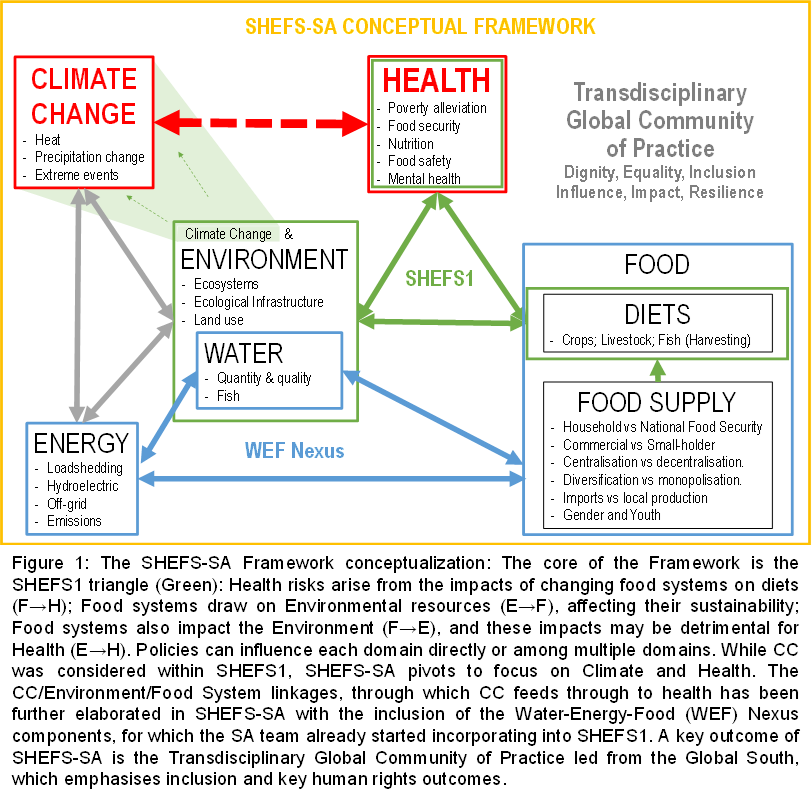
The SHEFS-SA programme adopts the broadened Water Energy Food Environment and Health (WEFEH) Nexus approach. Through this approach, the program directly addresses Water (SDG 6), Energy (SDG 7), Food (SDG 2), Environment (SDGs 13, 14, 15) and Health (SDG 3) alongside interlinked (interdisciplinary) goals such as SDGS 1 (1.3,1.5,1.6,1.7), 5, 10 and through the community of practice, the program speaks to SDGs 16 and 17.
Please see the programme’s conceptual framework below to visualise where each of these goals are considered.